
Most wine trails require a drive to reach. This one runs past the front door. The Pinot Noir Trail — Blauburgunderweg in German, Sentiero del Pinot Nero in Italian — is the longest wine walk in this corner of South Tyrol, and one of its loop variants passes through Gleno, the hamlet where the Hermann Hof apartments stand.
Where exactly is this?
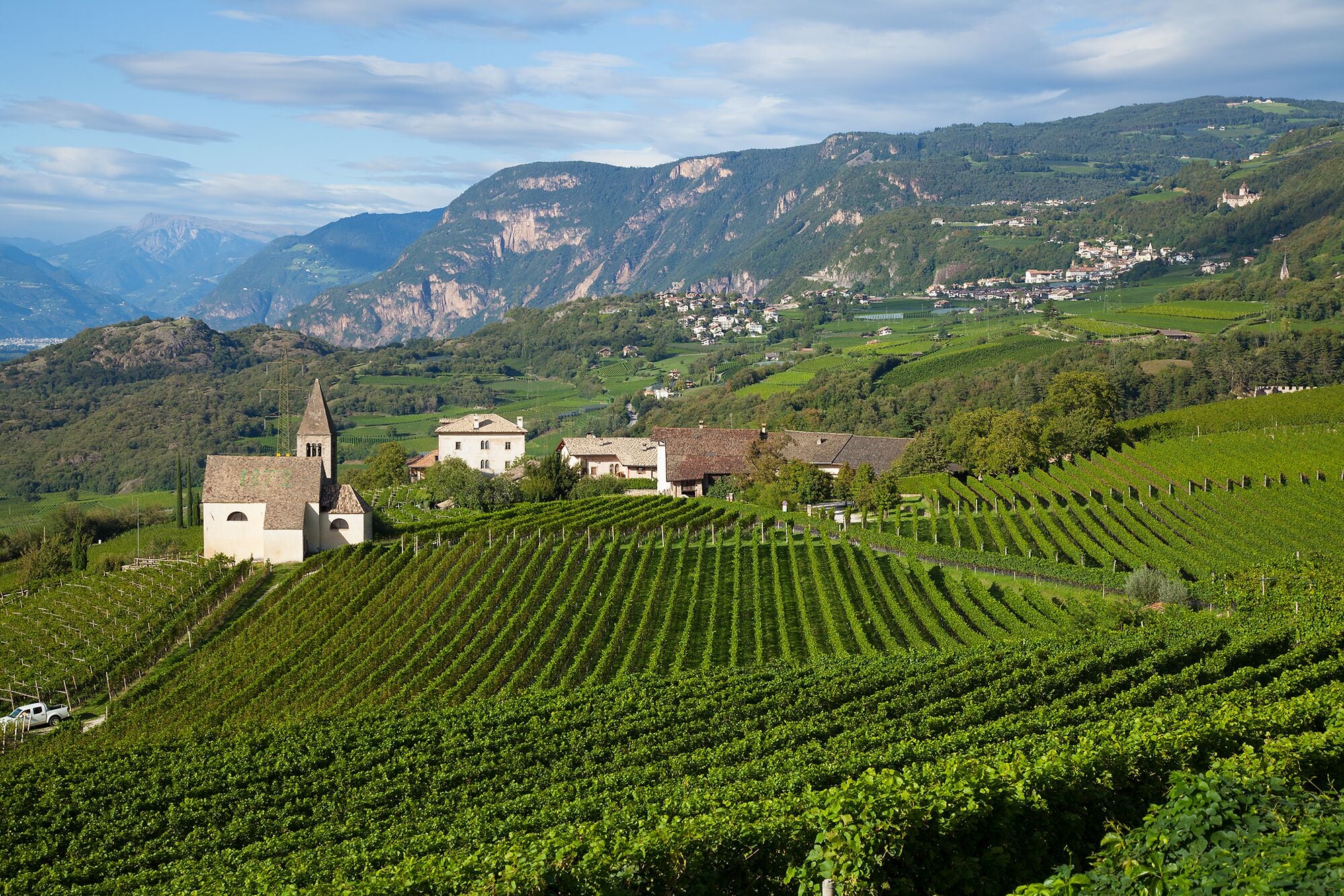
South Tyrol, northern Italy: the German-speaking Alpine province whose capital is Bolzano, on the southern edge of the Dolomites. The trail sits half an hour south of Bolzano in the lower Adige valley, the broad flat-bottomed valley carrying the river, the motorway and the railway towards Trento and Verona. Locals call this stretch the Südtiroler Unterland; the vineyard road threading through it is the South Tyrolean Wine Road (Südtiroler Weinstraße).
One thing to know before you plan: this is a bilingual area, so every village has two names and both appear on signposts. Ora is Auer, Montagna is Montan, Gleno is Glen, Pinzano is Pinzon.
How long is the Pinot Noir Trail?
16 km end to end, roughly 5 hours of walking, making it the longest wine trail in the area. It is a linear route with loop variants, so you can shorten it and still finish where you started. There are three access points — Ora, Montagna and Egna — and the vineyards lie on the slopes between Mazzon, Gleno and Pinzano.
One detail wine drinkers will appreciate: here the Pinot Noir zone climbs to 1,150 m, unusually high for a grape normally planted much lower. That altitude is what gives these wines their acidity and their reputation.
What are the three loop options?
- Ora – Montagna – Ora: 6.2 km, 1 hour 45 minutes, 260 m of ascent. The steepest climb out of the valley floor.
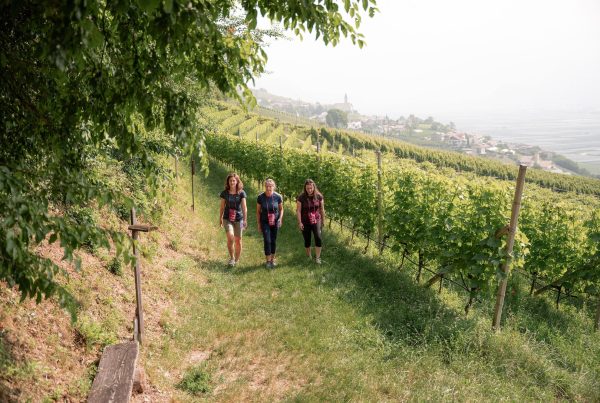
- Montagna – Gleno – Montagna: 4.1 km, 1 hour 15 minutes, 180 m of ascent. The shortest and gentlest, and the one that goes through Gleno.
- Egna – Mazzon – Villa: 7.9 km, 2 hours 30 minutes, 450 m of ascent. The most demanding, and the one that takes you into Mazzon itself.
Why the Montagna – Gleno – Montagna loop matters if you stay here
Because Gleno is on the route, not near it. The loop is 4.1 km, 1 hour 15 minutes and 180 m of ascent, and the hamlet where the apartments are is one of its waypoints. No driving to a trailhead, no parking, no shuttle: you walk out of the building, pick a direction and turn back whenever you like.
That makes it a walk you can repeat without it feeling like an expedition — after breakfast, or in the hour before dinner when the light goes low across the vines. It works with children too, given extra time: 180 m over 4 km is a gradual gradient rather than a haul.
Can you taste wine along the way?
Yes, but do not expect drop-in tasting rooms. The large cooperative wineries run shops with normal opening hours. The small estates — the majority here — usually receive visitors by appointment only, and the person pouring is often the person who made the wine. Email or phone the day before and the visit happens; turn up unannounced and you will likely find a closed gate.
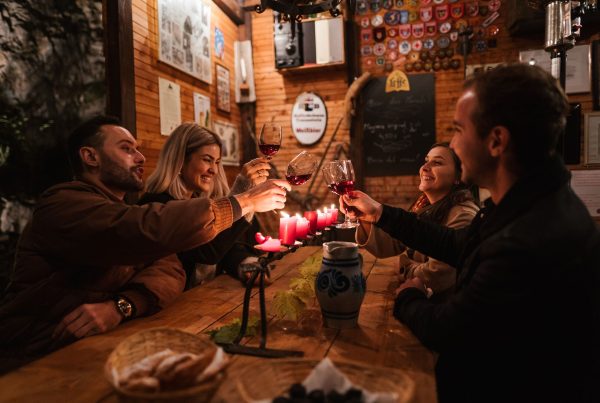
The walk-in alternative is a Buschenschank: a legally defined form of farm hospitality, in which a working farm serves its own wine and food on its own premises, for a limited number of days each year — which is why one may be open in October and shut in May. You recognise it by the Buschen, a bunch of branches hung by the door. Expect a short handwritten menu, farm wine, cold cuts and dumplings, and nothing in English.
When to come, and what the Pinot Noir Days are
Spring and autumn are the best seasons: spring for fresh growth and comfortable temperatures, autumn for the harvest and vine leaves turning deep red. In July and August these south-facing slopes get genuinely hot, so walk early or late.
The South Tyrolean Pinot Noir Days are the annual showcase, when local producers present new vintages and run comparative tastings. They take place in spring or early summer, with events spread across the villages of the area; dates and venue vary from year to year, so check the official programme before booking travel around them — and book accommodation well ahead, because the whole zone fills up.
Getting here, and what to bring
Reaching the trail without a car is possible with planning. The valley floor towns sit on the Bolzano–Trento railway line and connect to the hill villages by local bus, all on one integrated ticket; many hosts also issue guest cards covering buses and trains. Timetables are seasonal and evening services thin out early, and hillside hamlets are served far less often than the towns below them.
- Light walking or trail shoes — village lanes, vineyard tracks and gravel descents.
- Water: drinking fountains between the vineyards are not guaranteed.
- Sun hat and sunscreen from April to September.
- Cash: some Buschenschänke and small estates do not take cards.
From Hermann Hof
Gleno lies on the south-western slopes of Monte Cislon between 520 and 580 m, with 69 residents split between an upper and a lower settlement along the road towards Trodena. It is a scattered hamlet rather than a village: two lines of houses with vineyards and chestnut woods around them.
The five apartments at Hermann Hof occupy a converted farmhouse set in three hectares of woodland and Pinot Noir vines — a quiet base to set off from on foot. The advantage shows after the walk, when you do not have to drive: shower, open the bottle you bought at the winery, sit on the terrace and look at the slopes you crossed. The Montagna – Pinzano – Gleno loop (6.4 km, 2 hours) starts from the same doorstep, as does the cycle route along the old Val di Fiemme railway.
Photo: Marco Feola
Transparency note: this article was written with the assistance of artificial intelligence tools, based on publicly available sources, and checked by our team.